
💬Zepto's IPO Conversations💬
Puresta's Funding, Sleepcat's EBIDTA, DailyObjects' Revenue
Gully Labs thought it hired a CS exec. It accidentally hired its biggest customer.
In his first week, the employee reportedly created 100% discount codes, ordered nearly ₹2 lakh worth of sneakers for friends and family, and quit before the refund window closed, as detailed here. Half the shoes came back. The rest came with legal notices.
Founders obsess over CAC, ROAS, and influencer leaks. Meanwhile, one internal permission can wipe out a month of paid ads. While D2C companies are thinking about moats, internal controls matter!

🗞️Marketplace Buzz
Zepto pushing order growth into IPO conversations looks persuasive, but it reflects a model still losing ₹42– 46 on every transaction at contribution level. Cash burn compounds. With 2.37 million daily orders translating into about ₹11 crore outflow and only five to six quarters of runway left, the valuation debate tightens, and scale without structural margin will face sharper scrutiny.
Quick commerce scaling inside metros looks like channel diversification, but it reflects an alternate retail already commanding up to 50% of food category sales. General trade growth is flattening. With 65% expansion in quick commerce and 45% in ecommerce versus low single-digit growth offline, capital and inventory will follow velocity. Retail power is migrating from store networks to fulfilment grids, and Quick commerce is absorbing organised retail share.
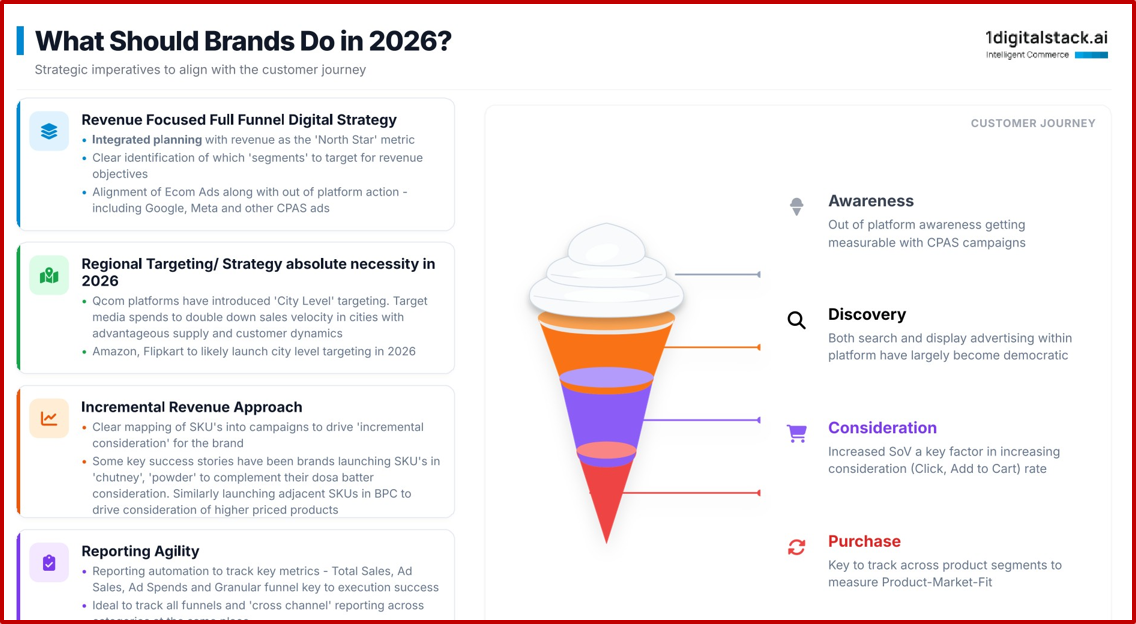
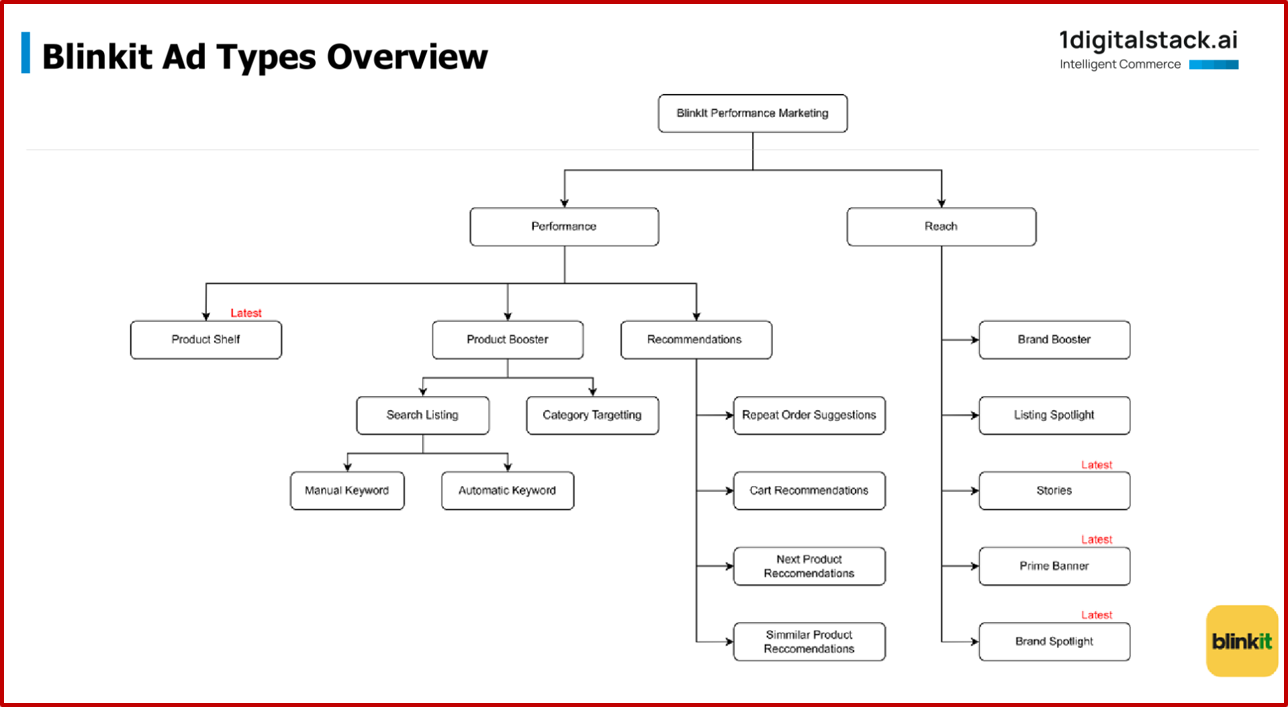
Blinkit, Zepto, and Instamart’s 550% CAGR in quick commerce ad revenue looks like a platform growth story, but it is actually D2C brands collectively building the toll booth they must pay to pass through every time a consumer opens a dark store app. Retail(EComm+QComm) media in India has crossed ₹29K cr annually, and they are not going to slow down. Just check the new ad formats introduced by QComm players in the must-read deck accompanying this Linkedin post.
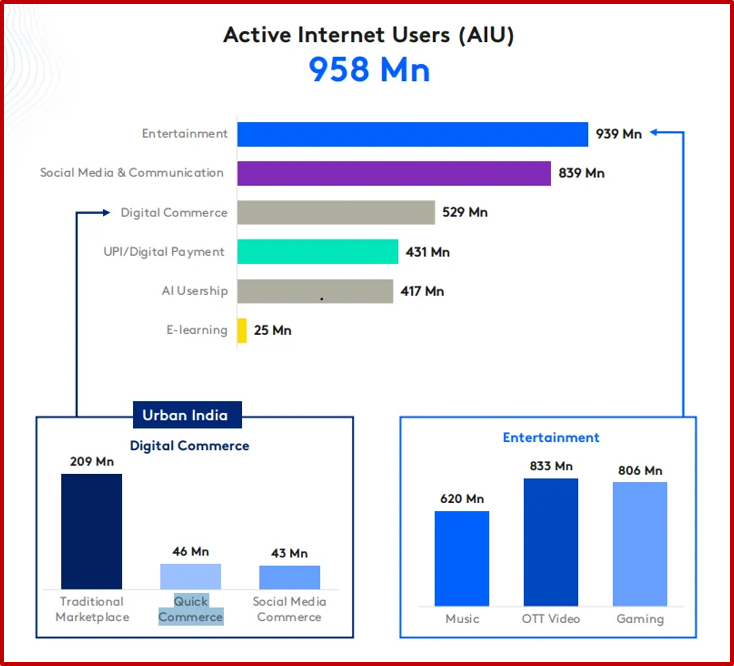
Meesho sits inside a 209 million-user marketplace block, but the real story is 548 million rural internet users growing at 4x the urban pace and buying through short video, local influencer endorsements, and social recommendations, no performance funnel can replicate. Rural India has already crossed urban users in raw numbers. Aspiration built this new Bharat shelf. Every D2C brand still running metro funnels is essentially optimising for yesterday’s growth story while Bharat builds tomorrow’s.
📊Infographica
🍕D2C Snippets
Puresta is turning beauty into a data problem by securing ₹34 crore pre-seed funding. This looks like category momentum, but it reflects founders moving from D2C grooming into AI-led dermatology infrastructure. Outcomes are the pitch. By integrating SKINQ’s dermatologist-formulated products into a full-stack platform with real-time tracking, the startup is chasing clinical credibility over viral packaging. Influencers get the views, but for skincare, the experts drive conversions.
SleepyCat posting ₹98 crore revenue in FY25 looks like D2C momentum, but it signals a business still spending ₹1.11 to earn ₹1 with EBITDA margin parked at -9.8%. Scale is expanding in lockstep with cost. Revenue rose 44% while total expenses climbed 44% to ₹108.5 crore and losses widened to ₹9 crore; looks like growth without operating leverage stretches the sleep cycle longer.

Home Essentials pulling in ₹70 Cr pre-Series B at just two years old looks like a premature bet, but 1 million customers and strong unit economics from inception signals that home and kitchen is the category D2C capital systematically underinvested in while chasing beauty and food for a decade. Founders still thinking about home essentials are watching the earliest moats get built in real time.
DailyObjects crossing ₹110 Cr in FY25 revenue while aggressively building into airport retail, exclusive brand stores, and 250 Apple premium reseller outlets. This looks like a textbook offline expansion, but it actually signals that fourteen years of digital-first curation have hit a ceiling performance marketing alone can no longer push past. Physical presence is now doing the discovery work that ads used to. Net losses climbed by 60%. The shelf moved; DailyObjects had to follow it.
MyDesignation securing ₹40 crore looks like growth capital, but it confirms D2C fashion is moving from digital-first to cluster-driven offline expansion. Geography matters. With in-house IP, one million customers and plans for a mobile app plus city-wise stores, the brand is tightening creative control while chasing ₹150 crore ARR. Clearly, MyDesignation is scaling beyond the Instagram rack.
BRND.ME’s cross-border composite merger completed in under 10 months looks like a legal housekeeping move, but it is actually the clearest proof that operational discipline and governance rigour are now the real IPO currency for D2C builders. ₹1,500 Cr in FY25 revenues, adjusted EBITDA positive, operating cash-flow positive. The GMV era is over. Public markets want clean structures, margin stories, and BRND.ME just filed the most convincing application.
Basil raising $2 Mn in pre-Series A may look like the usual “D2C kids brand goes to market with vibes and velocity,” but the plot twist is hidden in its Consumer Lab and a stack of industrial design patents. While everyone else is busy burning money on influencer reels, Basil is busy building category walls with pure product iteration. ₹36 Cr ARR in just two years, shipping to 20,000 pin codes, is not a vanity metric; it’s the scoreboard flashing in neon. Basil isn’t marketing its way to the top; it’s designing its way there.
ZeroHarm Sciences’ ₹65 Cr Series A looks like another nutraceutical fundraise, but the “Trust over Promise” positioning is a direct challenge to every supplement brand running efficacy claims with zero outcome data behind them. The wellness category is crowded with beautiful packaging and bold claims. Brands like Kapiva and Plix built distribution; ZeroHarm is betting that measurable consumer health results will eventually make distribution follow.
Wishlink’s $17.5M Series B may look like standard funding continuity at first glance — until you see the numbers. Creator-led checkout is now converting at an industrial scale, pushing ₹350 crore in monthly throughput. The funnel isn’t widening; it’s compressing. With 40,000 creators dropping 3 lakh content pieces every month and revenue blasting 356% in FY25, the monetisation layer has officially moved upstream. Creators aren’t just discovery; they’re the checkout counter.
📢Power Talk
“Historically, it took a lot of investment, time and effort to build distribution scale, but now that equation has got democratised because it is easier to reach a high number of high-spend consumers through e-commerce and quick commerce," Parul Bajaj, India leader- marketing, sales and pricing practice, BCG
📚Reads and Recommendations
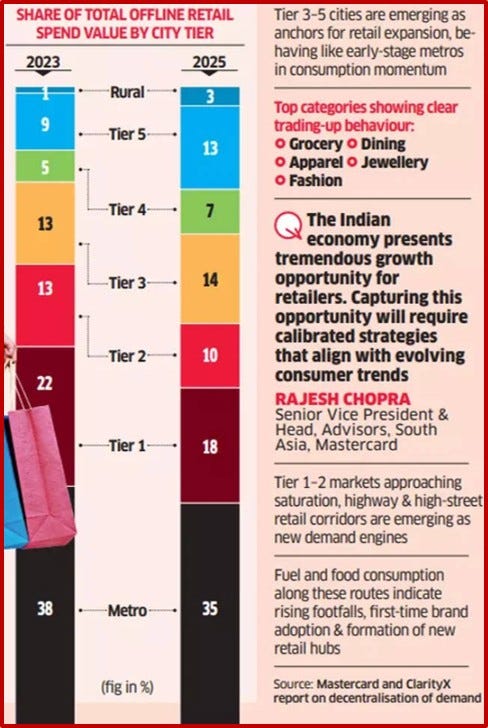
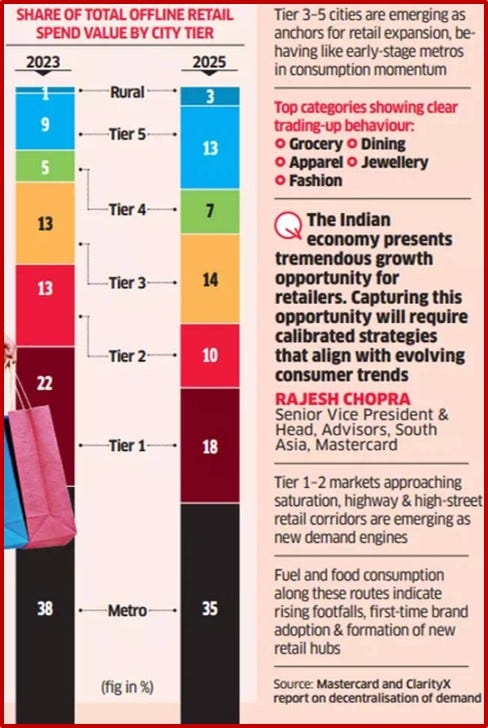
Tier 3–5 markets, once treated as distribution afterthoughts, now look like India’s fastest retail engines, growing nearly twice as fast as metros in 2025 . Demand is decentralising. With populations as low as 5,000 fuelling premiumisation across Fuel, Food and Fashion, highways and high streets are becoming full-fledged consumption corridors. The mall is no longer the default growth story.
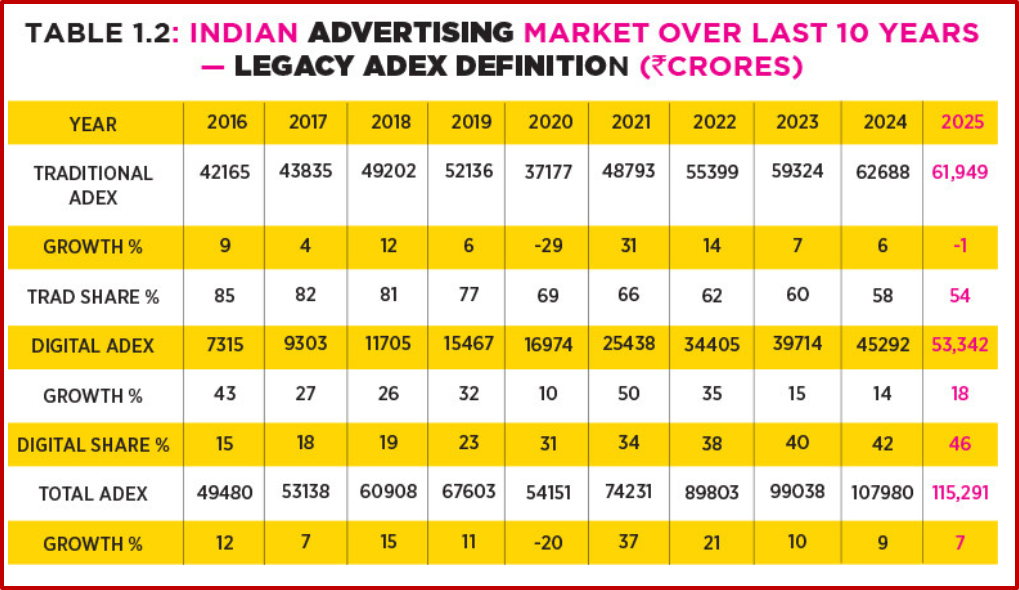
Madison World just killed the comfort of legacy planning. It has just reframed India’s AdEx math and confirms Digital as the structural spine of a ₹1,55,105 crore market. With ₹93,156 crore in Digital spend and Traditional shrinking while Digital absorbs over 100% of incremental growth, budget reallocation is now a zero-sum game.
Minimalist’s growth on Nykaa looks like D2C skincare winning, but Nykaa crossing ₹5,795 Cr GMV with owned brands scaling at 65% YoY reveals the exact mechanics of how that growth works against independent brands. The customer discovers on Nykaa, stays loyal to Nykaa, and the platform competes in the same category with better margins and superior shelf placement. Every rupee a D2C skincare brand spends on Nykaa ads is training the algorithm that will eventually recommend a Nykaa-owned alternative instead.
ChatGPT driving just 1.48% of non-branded organic revenue looks marginal, but it signals 31% higher conversion rates at 1.81% versus 1.39% for traditional search. Intent is pre-qualified. Across 94 ecommerce brands, AI referrals generated $3.65 revenue per session versus $3.30 from organic, despite lower AOV. Discovery is shifting from keywords to conversations.
🔥That’s all for this week! As always, share this with your fellow D2C hustlers, and let’s keep the community growing. And don’t forget to be generous with hugs. You never know when a genuine hug makes someone’s day
PS: Folks at some companies have told us this newsletter is almost mandatory weekly reading for their teams 🥰. If your company is not in on it yet, get your teams on the latest in the e-commerce space every week.